
From fragmented support to a value-enabling hub
A global legal technology leader used a Tier 4 assessment to expose governance gaps and redesign its PMO around five service areas.
- Start
- 20 Mar 2025
- Assessment level
- Tier 4
- Current maturity
- Level 2
- Current impact
- Level 2
- Future state
- Maturity 4, Impact 3+
Where it started.
A global leader in legal technology and enterprise legal services operated a Legal Transformation Services PMO that was active across eDiscovery, document review, risk management, and legal consulting. While the PMO offered a broad mix of operational, tactical, and strategic services, it faced systemic issues that hindered its ability to deliver value across the organization consistently.
Although the PMO was engaged in mission-critical work, challenges around governance, fragmented systems, inconsistent delivery quality, and limited visibility of capacity and skills led to operational inefficiencies. Executive leadership recognized that the PMO had potential, but required a structured approach to realize it. An official PMO-MI® partner was brought in to conduct a deep-dive assessment and help redesign the PMO to align with enterprise-wide objectives.
What the assessment showed — and what was done.
Conducted a Tier 4 maturity and impact assessment
The team executed a structured diagnostic assessment using the PMO-MI® model. This included interviews, service maturity evaluations, organizational mapping, and the identification of hotspots such as sales misalignment, pricing inconsistencies, ineffective risk controls, and poor visibility of resource capabilities. The PMO scored at Maturity Level 2 (Developing) and Impact Level 2.
Diagnosed root causes and systemic issues
Analysis and stakeholder mapping revealed that fragmented governance, unclear decision-making frameworks, and the absence of standardized tools (e.g. pricing models, KPIs) were contributing to performance issues. Delivery inefficiencies were linked to scope creep, inadequate training, and misalignment between sales and project teams.
Defined a Target Operating Model and service strategy
A PMO Target Operating Model (TOM) was designed to transition the PMO from reactive support to a value-enabling hub. The new TOM focused on five key service areas: Sales, Financial Planning and Analytics, Governance & Reporting, Delivery, and Resource Management. The design included frameworks for service prioritization, project classification, CRM integration, and improved financial control.
Developed a phased execution roadmap
A five-step roadmap was defined — from stakeholder alignment to phased rollout and performance feedback loops. The roadmap allowed the PMO to build maturity progressively while addressing high-priority issues in the short term.
Maturity and impact, plotted.
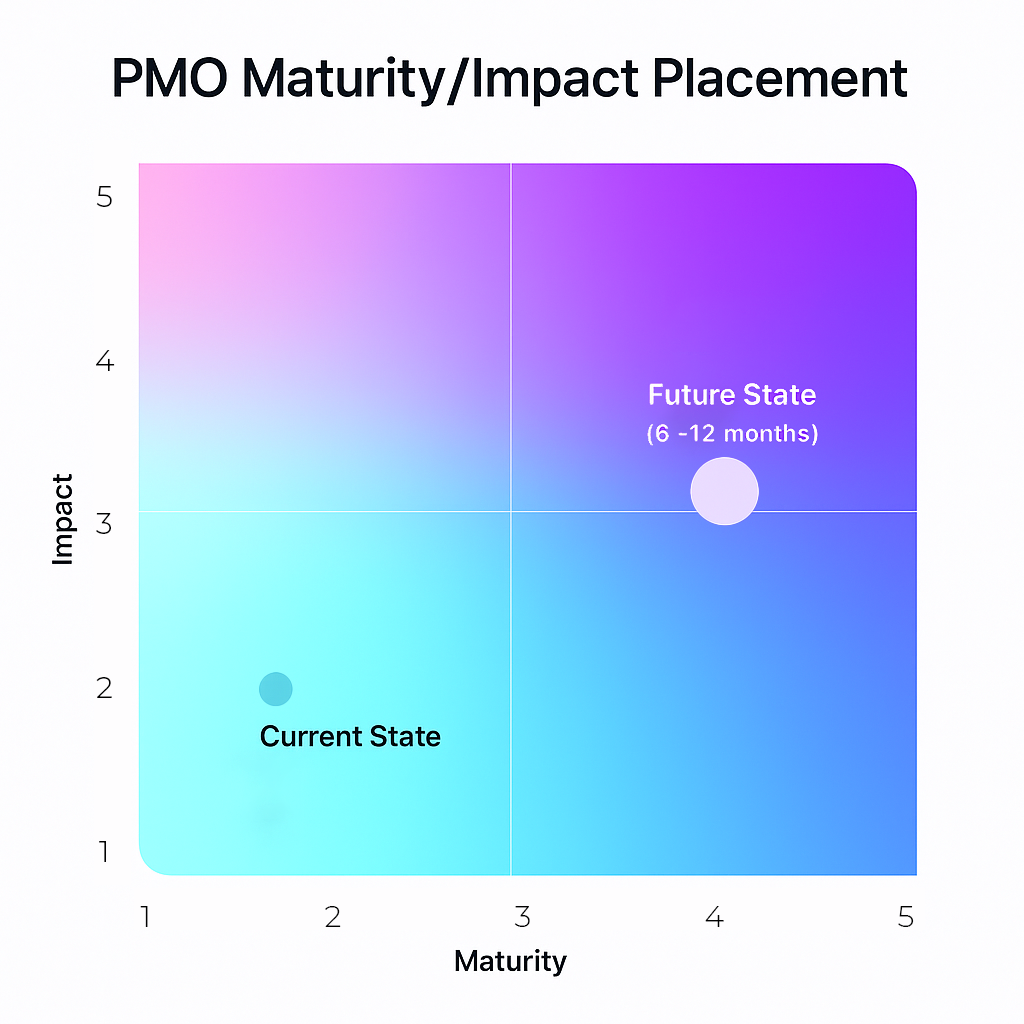
Current state at maturity 2 / impact 2, with a future state at maturity 4 / impact 3+ within 6–12 months.
Where it stands now.
- Identified and prioritized key hotspots across sales, delivery, governance, and finance.
- Formalized a standardized PMO service offering across five domains.
- Gained executive alignment on PMO transformation strategy and governance model.
- Initiated development of enterprise-wide tools for pricing, CRM, and reporting.
- Established PMO credibility through structured roadmap and stakeholder communication.



Let's elevate your PMO.
Book your assessment and see where your PMO stands — on evidence, not opinion.